Database schema
A CReM fragment database is a single SQLite file. CReM reads two formats:
- v1 — the current, deduplicated schema written by
cremdb_create. Identified byPRAGMA user_version = 1. - v0 — the legacy single-table-per-radius layout written by the
pipeline. Identified by
PRAGMA user_version = 0(the default).
Every generation function works with both formats. Older v0 databases can be converted into v1.
To check a database's format:
sqlite3 fragments.db "PRAGMA user_version;" # 1 = v1, 0 = v0v1 schema (current)
v1 normalizes the data into shared tables so that each environment, fragment, and H-capped fragment is stored only once, then references them from per-radius mapping tables.
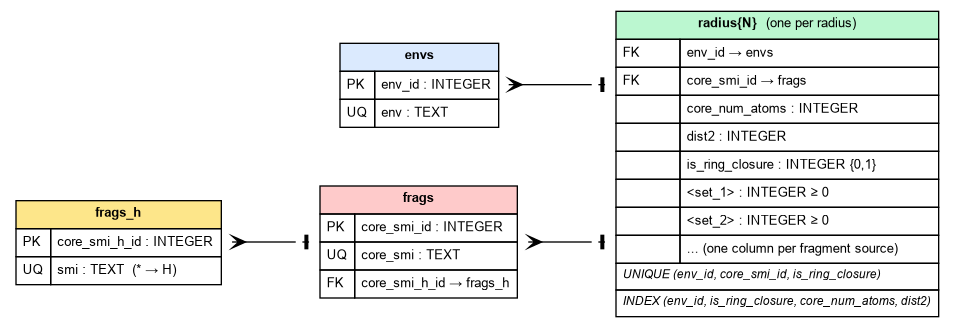
envs — context environments
CREATE TABLE envs(
    env_id  INTEGER PRIMARY KEY AUTOINCREMENT,
    env     TEXT NOT NULL UNIQUE
);
One row per distinct canonical context (environment) SMILES.
frags_h — H-collapsed fragments
CREATE TABLE frags_h(
    core_smi_h_id  INTEGER PRIMARY KEY AUTOINCREMENT,
    smi            TEXT NOT NULL UNIQUE
);
Each core fragment with every attachment point [*] replaced by hydrogen.
This groups together cores that differ only in where they attach. Deduplicated
by this H-collapsed SMILES.
frags — fragments (cores)
CREATE TABLE frags(
    core_smi_id    INTEGER PRIMARY KEY AUTOINCREMENT,
    core_smi       TEXT NOT NULL UNIQUE,
    core_smi_h_id  INTEGER NOT NULL,
    FOREIGN KEY (core_smi_h_id) REFERENCES frags_h(core_smi_h_id)
);
One row per distinct core SMILES (with attachment points). Optional
property columns (mw, logp, …) are added to this table on
demand and are therefore not present in a freshly built database.
radiusN — context-to-fragment mapping (one per radius)
CREATE TABLE radius3(
    env_id           INTEGER NOT NULL,
    core_smi_id      INTEGER NOT NULL,
    core_num_atoms   INTEGER NOT NULL,
    dist2            INTEGER NOT NULL,
    is_ring_closure  INTEGER NOT NULL DEFAULT 0,
    -- one INTEGER frequency column per fragment set, e.g.:
    chembl           INTEGER NOT NULL DEFAULT 0,
    FOREIGN KEY (env_id)      REFERENCES envs(env_id),
    FOREIGN KEY (core_smi_id) REFERENCES frags(core_smi_id),
    UNIQUE (env_id, core_smi_id, is_ring_closure)
);
Each row links a context (env_id) to a core (core_smi_id) observed in that
context at this radius. Columns:
| Column | Meaning |
|---|---|
core_num_atoms |
heavy-atom count of the core (denormalized here so size filters need no join) |
dist2 |
topological distance between the two attachment points for 2-attachment cores; 0 otherwise |
is_ring_closure |
0 for acyclic-cut fragments, 1 for ring-cut (ring-closure) fragments — see frag modes |
| set columns | one per fragment set; the value is the occurrence count in that set |
Because is_ring_closure is part of the UNIQUE key, the same
(env, core) pair can store an acyclic row and a ring-closure row
independently, each with its own per-set counts.
Indices
The UNIQUE constraints already create autoindices on envs(env),
frags(core_smi), frags_h(smi), and
radiusN(env_id, core_smi_id, is_ring_closure). In addition, exactly one
covering index per radius supports the hot query path:
CREATE INDEX idx_radius3_lookup
    ON radius3(env_id, is_ring_closure, core_num_atoms, dist2);
How a query uses it
At generation time CReM resolves the molecule's context to an env_id, then
selects matching cores from radiusN filtered by core_num_atoms (size),
dist2 (linker/ring geometry), is_ring_closure (provenance), and the chosen
set column against min_freq. The selected core_smi_ids are joined to frags
to obtain the replacement SMILES.
v0 schema (legacy)
v0 stores everything denormalized in one table per radius:
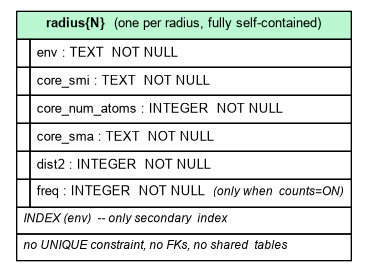
CREATE TABLE radius3(
    env             TEXT,
    core_smi        TEXT,
    core_num_atoms  INTEGER,
    core_sma        TEXT,      -- core reaction SMARTS
    dist2           INTEGER,
    freq            INTEGER    -- present only when built with occurrence counts
);
CREATE INDEX radius3_env_idx ON radius3(env);
The freq column exists when the database was built from sort | uniq -c
counts (see the v0 pipeline). v0 has no notion of multiple
fragment sets or ring-closure provenance; set_names is ignored for v0
databases.
When filtering fragments with extra **kwargs (property filters), v0 reads the
named columns from the radiusN tables, whereas v1 reads them from frags /
frags_h.